• Services · Commercial premises ——
Fire Risk Assessment for
Commercial Property.
A commercial fire risk assessment is a legally required review, carried out to PAS 79-1, that identifies fire hazards in your premises and sets out the actions needed to protect staff, visitors, and the building itself. Every assessment is carried out personally by Ray Amoah (ABBE Level 4, DipFRA, MIFSM, FPA), with a fixed fee agreed before any work begins.
Fixed fees from £225 · Reports from 48 hours
What we assess in your premises
Named assessor
Fixed fees from £225
Reports from 48 hours
PAS 79-1 methodology
Multi-site discounts
MK, Bedford & London
• The basics ——
What is a commercial
fire risk assessment?
It applies to virtually any non-domestic building, including offices, shops, warehouses, workshops and mixed-use premises, and is a legal duty under the Regulatory Reform (Fire Safety) Order 2005, not an optional extra. The law requires the assessment to be “suitable and sufficient” for your specific building and how it is actually used. A generic checklist, downloaded from the internet or copied from a similar-looking building, will not hold up if it is ever tested by an enforcing authority or an insurer following an incident.
Under the legislation, the “responsible person” is whoever has control of the premises, typically the employer, the building owner or the occupier. Where a building has multiple occupiers, such as a serviced office block or a parade of shops with a shared rear access, there can be more than one responsible person, each accountable for the parts of the building they control.
In practice, a fire risk assessment produces two things: a written record of the hazards found, and a prioritised action plan setting out what needs fixing immediately, in the short term, and in the longer term.
• Cost & process ——
Fixed fee.
No surprises.
Commercial fire risk assessments start from £225 for smaller premises, scaled to size and complexity, with a fixed-fee quote agreed before any work begins. Floor area and storeys, shared plant rooms or communal areas, how complex the use of the space is, and whether this is a first assessment or a periodic review all affect the price. You’ll have a fixed number in writing before the site visit is booked.
01
Scoping & quote
A short conversation about your premises is enough to provide a fixed-fee quote before any work begins.
02
Site visit
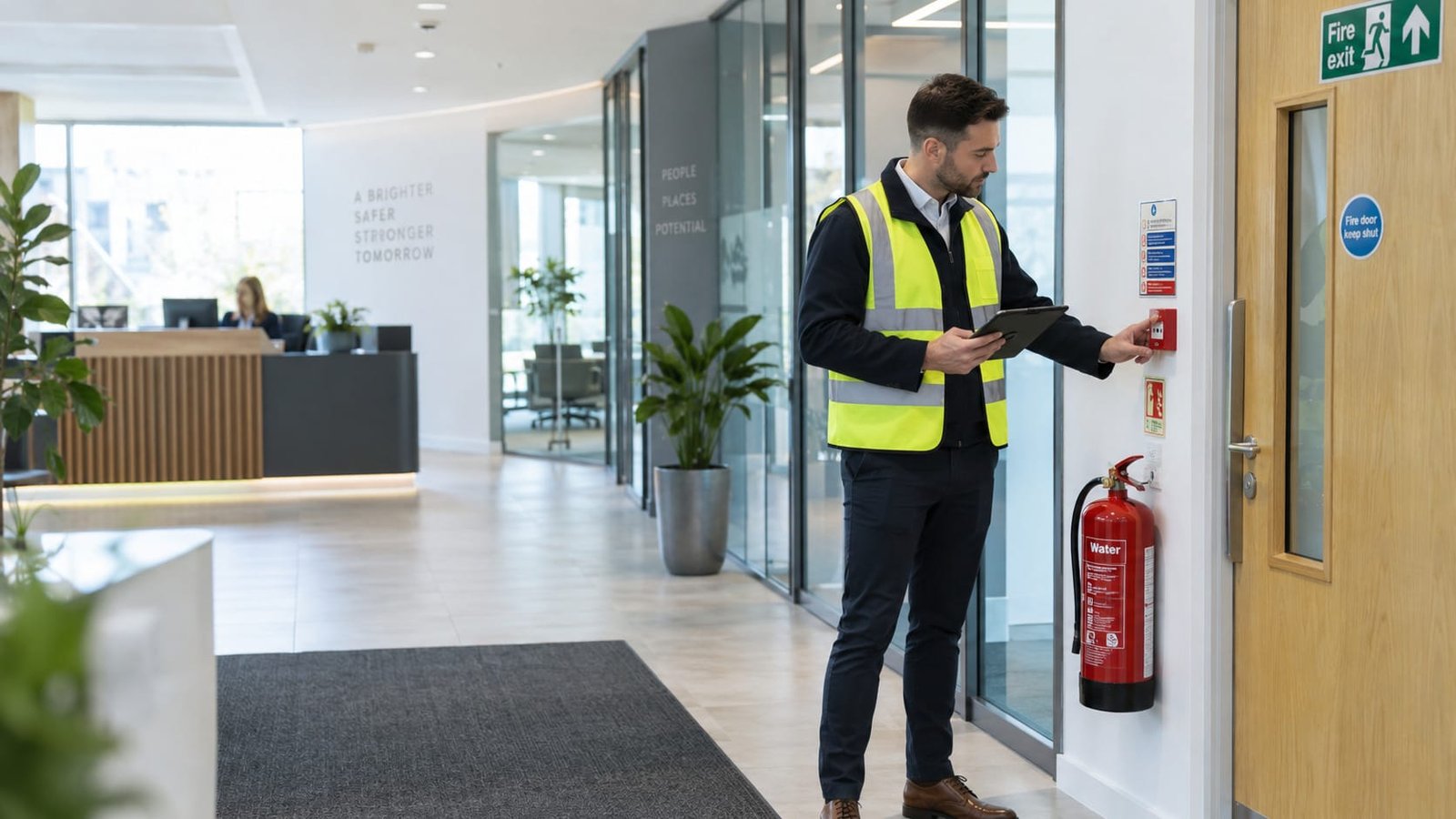
A full, methodical walk-through of the premises: escape routes, detection, compartmentation, storage and management.
03
Report & action plan
A digital, photo-backed report delivered from 48 hours after the visit, with hazards clearly prioritised.
04
Ongoing support
Not a one-off certificate. Reviewed on schedule, with support in between.
• Who needs one ——
Is it your
legal duty?
Anyone responsible for a non-domestic building (employer, owner, occupier or landlord) is legally required under the Regulatory Reform (Fire Safety) Order 2005 to hold a current, suitable and sufficient fire risk assessment.
If you’re a landlord or managing agent responsible for a mixed-use or multi-let building, the duty typically extends to shared corridors, stairwells and plant rooms, even where individual tenants are separately responsible for their own units. Getting this split wrong is one of the most common gaps we find.
• Scope ——
What a commercial assessment covers.
Means of escape & travel distances
Whether people can get out quickly and safely from anywhere in the building, including whether escape routes stay clear in practice.
Fire detection & alarm systems
Suitability and coverage for your building type, and whether the system matches how the building is actually used today.
Emergency lighting
Adequate illumination of escape routes if the power fails, particularly in internal corridors with no natural light.
Compartmentation & fire doors
Whether fire and smoke are contained long enough for safe evacuation, including whether doors are maintained and not wedged open.
Flammable & combustible storage
A common failure point in retail and industrial premises, where stock accumulates faster than storage is reviewed.
Fire safety management
Staff training, drills, and how the fire safety policy is documented. Even a well-designed building fails if people don’t know what to do.
• Standards & compliance ——
Assessed to
PAS 79-1.
Commercial premises are assessed to PAS 79-1, the recognised methodology for general fire risk assessment across offices, retail, industrial and mixed-use buildings. This is different from BS 9792:2025, the standard for housing, used for our blocks of flats and HMO assessments. An assessment that cites the wrong standard is a warning sign that it may have been adapted from a template.
01
How often to review
PAS 79-1 recommends review at least annually, and immediately after any significant change to the building, occupancy or use, consistent with your ongoing duty under the Fire Safety Order to keep the assessment current.
02
Common review triggers
A change of use, a refurbishment or extension, a fire or near-miss incident, a significant change in the number of people using the building, or new fire safety legislation coming into effect.
03
Who enforces compliance
Your local Fire and Rescue Service enforces the Fire Safety Order. It can inspect commercial premises, issue enforcement or prohibition notices, and prosecute where a responsible person has failed to comply.
04
Insurance
Insurers routinely request the current fire risk assessment when handling a claim after a fire. A missing or clearly inadequate assessment is one of the most common reasons a claim is disputed or reduced.
• Sectors we cover ——
Buildings we work on.
Not every commercial building need is met by a fire risk assessment alone. A fire risk assessment reviews an occupied building’s ongoing fire safety management, while a fire strategy report sets out how a building’s design achieves fire safety in the first place. If you’re developing a new building, carrying out a major refurbishment, or need to show fire safety design principles for planning or building control, you may need one instead of, or alongside, an assessment.
• Why Vigilance ——
Built on rigour.
Accountable by name.
Fire risk assessments are only as good as the person carrying them out and the methodology they’re assessed against.
01
Named, accountable assessor
Every assessment is carried out personally by Ray Amoah: ABBE Level 4, DipFRA, MIFSM, FPA member. You deal directly with your assessor, not a call centre.
02
PAS 79-1 methodology
Assessed to the current recognised methodology, not a legacy template carried over from an older standard.
03
Fixed fee, no surprises
Quoted before the site visit. What you’re told is what you pay.
04
Fast, without cutting corners
Digital report delivered from 48 hours after the site visit.
• Credentials & memberships ——
Qualified. Insured. Accountable.
ABBE L4
Level 4 Diploma, fire risk assessment
DipFRA
Diploma in fire risk assessment

Institute of Fire Safety Managers

Fire Protection Association

5-star rated on Trustpilot & Google
PI
Professional indemnity insured
• Client feedback ——
What clients
say.
Great experience using Vigilance Fire Safety. They are very knowledgeable and professional. Highly recommend!
Parkview Estates · Read more reviews
• Related services ——
How else we can help
Fire strategy reports
Bespoke strategies for complex, new or refurbished buildings, with tailored pricing.
Also covering: Milton Keynes · Bedford · St Albans · Aylesbury · Northampton · Luton. New to this? Read our plain-English guide to fire risk assessments.